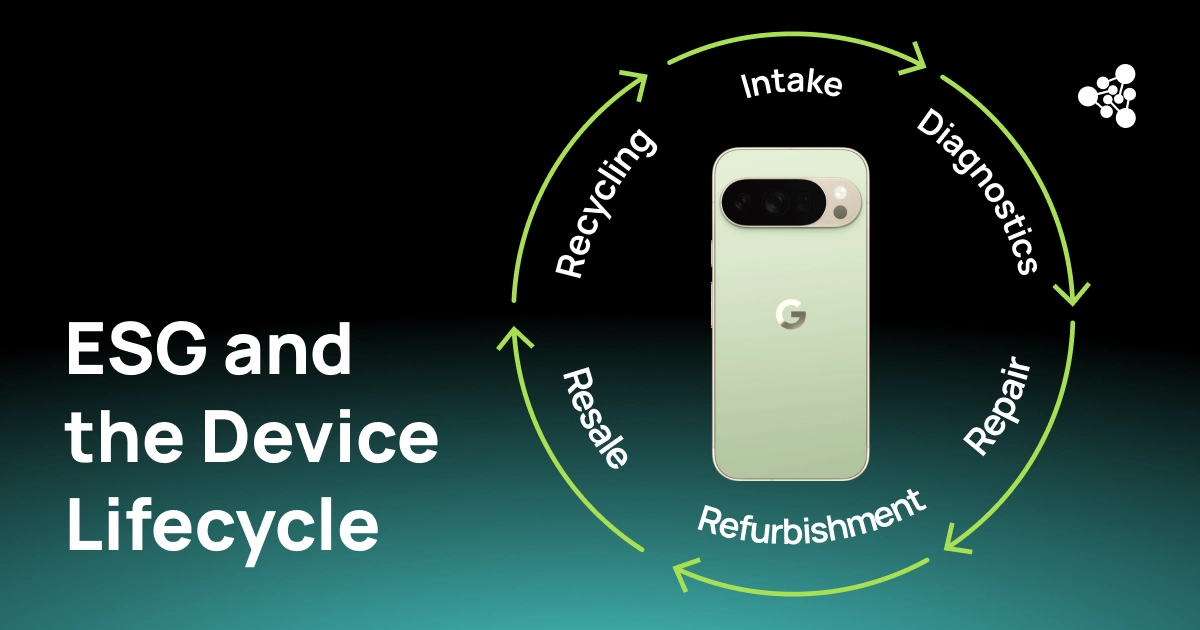
For companies working with used mobile devices, ESG shows up in daily operational questions: How are returned devices assessed? Can they be repaired or resold? How is previous-user data removed? Can the business prove what happened to each asset?
For refurbishers, wholesalers, retailers, and ITAD providers, these questions tie sustainability to compliance, operational control, and asset value.
Key takeaways
- Reuse, repair, refurbishment, and recycling form the environmental core of ESG for device businesses.
- Supplier due diligence surfaces environmental, labor, and human rights risks.
- Device-level records make ESG reporting possible.
- Secure data erasure is a governance requirement before resale or redeployment.
What ESG Means for a Mobile Device Business
ESG in supply chain management covers environmental, social, and governance factors across suppliers and internal operations. For mobile device businesses, that means e-waste and resource use, labor conditions across the supply chain, supplier oversight, data protection, and documentation for compliance.
Why It Matters
Materials and manufacturing account for 70–90% of a smartphone's lifecycle emissions, according to GSMA. Extending device lifespans through reuse, repair, and refurbishment reduces the environmental impact of producing replacement devices (GSMA, Mobile Device Circularity).
More than 5 billion mobile phones are currently sitting unused in homes and offices worldwide, per GSMA data. Industry efforts increasingly focus on getting these devices collected and routed toward repair, reuse, or responsible recycling (GSMA, Reuse, Refurbish and Recycle).
This creates a concrete operational question: how many incoming devices can realistically be kept in use, and how reliably can that call be made at scale?
Three Places ESG Risk Lives
Device assessment. A defective device is often assumed to be e-waste when it could still be repaired, refurbished, or resold. The disposition decision depends on consistent condition data. Businesses that assess devices inconsistently scrap units that could have stayed in circulation. Diagnostic tooling — as NSYS Diagnostics, which runs 60+ tests covering 100+ possible hardware defects — standardizes the condition data that decision depends on.
Supplier and partner risk. Manufacturers, logistics providers, repair centers, and recyclers can each introduce ESG risk through labor practices, environmental compliance, or waste handling. A practical review process has four steps: map critical suppliers and processes, assess environmental and labor risk per supplier, monitor through documentation and KPIs, and escalate when requirements aren't met. Depth of review should scale with supplier risk level.
Data protection before resale. Previous-user data needs to be removed through a controlled, auditable process before a device reaches a new owner. Businesses need to produce proof of erasure on demand, which is a governance requirement as much as a technical one. NSYS Data Erasure, for example, generates an erasure certificate aligned with NIST, ADISA, and R2 requirements.
Traceability Connects the Three
These three areas become ESG evidence only when they're tracked consistently: IMEI, diagnostic result, grade, processing status, and final disposition, connected across the device's lifecycle rather than siloed by department. NSYS Inventory structures this around IMEI-based records. Without this layer, a business can be doing the right things operationally and still struggle to prove it to a customer, auditor, or regulator.
A Practical Starting Checklist
There's no universal ESG checklist — requirements vary by market, customer base, and regulation. Five questions are a reasonable starting point:
- Can we identify the suppliers and partners involved in our processes?
- Can we track what happens to each device after intake?
- Do we have consistent criteria for resale, repair, refurbishment, and recycling?
- Can we document secure data erasure with evidence?
- Can we produce that evidence when a customer, auditor, or regulator asks?
Gaps in these answers usually point to where controls or tooling are needed.
The Business Case
Strong ESG practices reduce avoidable waste, tighten supplier control, protect customer data, and produce records that hold up under audit. GSMA identifies longer device lifespans, repair, and refurbishment as levers for reducing value-chain emissions and recovering value from devices that would otherwise be scrapped (GSMA, Mobile Net Zero 2026).
For companies processing used devices, accurate assessment and documented processing determine which assets return to market.
FAQ
How is ESG different from recycling more?
Recycling is one output. ESG also covers supplier labor conditions and whether your records can prove your practices to a third party.
Where should a business start with no ESG process today?
Usually with disposition consistency — standardizing how repair-versus-scrap decisions get made. It affects waste volume directly and tends to be the least documented process in most businesses.
Does ESG documentation slow down operations?
Less so when it's built into existing workflows like diagnostics, grading, inventory, and erasure, rather than added as a separate reporting layer afterward.
Who asks for this evidence — customers or regulators?
Increasingly both. Enterprise and carrier customers are asking ITAD and refurbishing partners for documentation as a condition of doing business, often ahead of formal regulatory mandates.